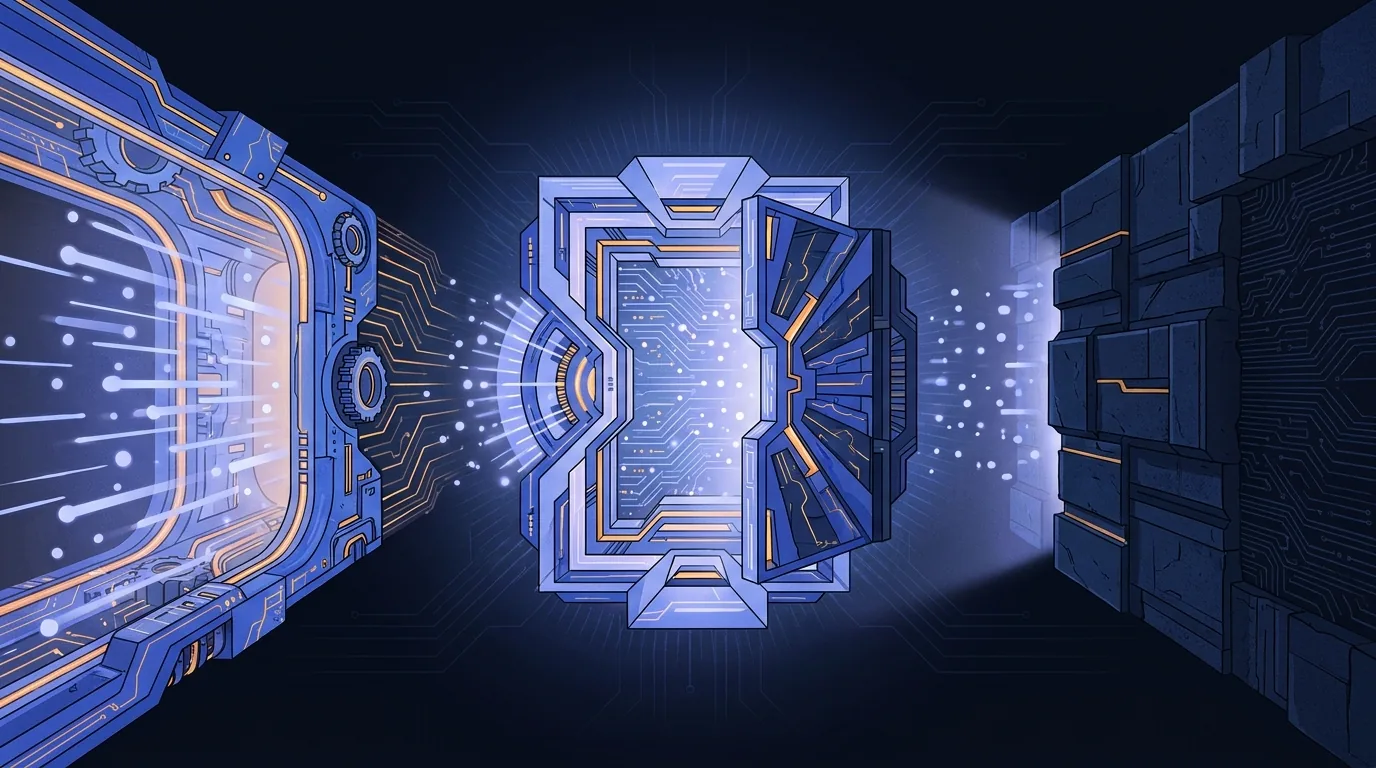
One property, a spectrum of behaviour
It is tempting to sort every material into three neat boxes — conductor, insulator, semiconductor. The truth is smoother and more useful: they are three regions of a single continuous scale. That scale is electrical conductivity, and it is astonishingly wide. Copper conducts about a billion billion times better than quartz — a span of some twenty-six orders of magnitude, wider than the gap between a mountain and an atom.
Underneath that one number sits a single physical question: how free are the material's electrons to move? In a conductor they roam almost unhindered. In an insulator they are locked in place. A semiconductor sits in between — and, uniquely, it can be nudged from one behaviour toward the other. Slide the control below to see where the three materials land.
Pure silicon barely conducts — but doping and a gate voltage move it across seven orders of magnitude on command. A door you control.
Notice what the picture is really saying. Copper and quartz sit at fixed points — nothing you can practically do moves them. Silicon is the one material whose position you can slide, and that is the entire reason the industry cares about it.
Conductors: the hallway
Metals like copper, silver, and aluminium share a defining trait: their outer electrons are only loosely tied to any one atom. Instead they pool into a shared "sea" that drifts freely through the whole metal. Apply even a tiny voltage and the sea flows — that flow is electric current, and it meets almost no resistance.
This makes metals superb at carrying electricity: power lines, the wiring in your walls, the fine interconnect between transistors on a chip. But it also makes them hopeless at deciding. A metal is a hallway with no doors. Current always flows; you cannot tell it to stop. For carrying signals that is exactly what you want. For building logic — which needs an off as much as an on — it is a dead end.
Insulators: the wall
At the far end sit insulators — quartz, glass, rubber, most ceramics and plastics. Here every electron is spoken for, bound tightly into the chemical bonds that hold the material together. There is no free sea to push around. To make current flow you would have to rip electrons out of their bonds, and that takes an enormous jolt of energy — enough that, in normal use, essentially nothing crosses.
That reliability is exactly why we prize insulators. The rubber around a cable, the ceramic in a spark plug, the glassy layer that separates the metal lines on a chip — all of them are walls we want to stay shut. An insulator is a wall. And a wall, like a hallway, has exactly one setting.
A conductor's electrons are always free to move; an insulator's are always locked away. What actually makes a semiconductor useful?
Semiconductors: the door
A semiconductor sits in the middle — and it is easy to misread that as "a mediocre conductor." Pure silicon really is a poor conductor at room temperature. But the middling number is not the point. The point is that the number moves, and moves dramatically, in response to things you control:
- Temperature. Heat frees more electrons, so a semiconductor conducts better when warm — the opposite of a metal.
- Light. A photon can knock an electron loose. That is how solar cells and camera sensors turn light into current.
- Doping. Adding a trace impurity — about one atom in a million — permanently raises conductivity by orders of magnitude and sets the material's type.
- An applied voltage. The electric field from a nearby gate opens or closes a conducting channel — the effect that does the switching inside every transistor.
So a semiconductor is neither hallway nor wall. It is a door — and, crucially, a door you control. Apply a voltage and it swings open, letting current through; remove it and the door shuts. Same material, two opposite behaviours, switched billions of times a second.
You want to build a logic gate — something that can represent both 1 and 0. Why won't a block of pure copper do the job?
Why the middle is the only place logic can live
Now the spectrum pays off. A switch — the atom of all computing — must be able to sit in both states, on and off, on demand. A metal is stuck open: it can represent a 1 but never a 0. An insulator is stuck shut: a 0 but never a 1. Only the controllable middle can be commanded into either state and flipped between them, which is precisely what a bit of information requires.
Wire a few of these controllable doors together and you get logic gates. Wire billions together and you get a processor. The whole towering edifice of digital technology rests on a single quiet fact: there exists a class of materials whose conductivity you can switch. We call them semiconductors, and silicon is the one that won — for reasons of crystal, band gap, and a lucky layer of home-grown glass.
The deeper "why" behind that switchability is a piece of physics called the band gap — the energy staircase an electron must climb to break free. And the way engineers turn one flavour of silicon into two, then stack them into diodes and transistors, is doping. Each has its own deep dive.
Key takeaways
- Conductor, insulator and semiconductor are three regions of one continuous scale — electrical conductivity, spanning ~26 orders of magnitude.
- A conductor (copper) always conducts — a hallway; an insulator (quartz) never does — a wall. Both have a single, fixed setting.
- A semiconductor (silicon) sits between them, and its conductivity can be moved across orders of magnitude by heat, light, doping, and voltage — a door you control.
- That controllability, not the middling value, is the point: only a switchable material can represent both 1 and 0, so only semiconductors can build logic.
Frequently asked questions
What is the difference between a conductor, an insulator, and a semiconductor?
It comes down to how freely a material lets electrons move. A conductor (like copper) has a sea of loose electrons and carries current almost effortlessly — always. An insulator (like quartz or rubber) locks its electrons into bonds, so current essentially never flows. A semiconductor (like silicon) sits between the two, and — crucially — its conductivity can be changed on command by temperature, light, doping, or an applied voltage. That controllability, not the middling value, is what makes it special.
Is a semiconductor just a bad conductor?
No — that misses the point. Pure silicon is indeed a poor conductor, but the reason it runs the world is that its conductivity is not fixed. Add a trace of a dopant and it climbs by a factor of a million; apply a small voltage and it switches between conducting and blocking billions of times a second. A 'bad conductor' with a value you cannot change would be useless for logic. A controllable one is the foundation of every chip.
Can the same material act as both a conductor and an insulator?
Yes — that is exactly what a semiconductor does. Silicon can be made to conduct (door open) or to block (door closed) using a small control voltage, and it flips between the two states on demand. Metals cannot do this — they are stuck conducting — and insulators cannot either — they are stuck blocking. Only a semiconductor offers both behaviours in one material.
Why can't you build a computer chip out of metal or out of an insulator?
Logic needs a switch — something that can be both on and off on command. A metal is a hallway with no doors: current always flows, so it can carry signals but can never represent a 0. An insulator is a wall: current never flows, so it can never represent a 1. A semiconductor is the door in between, and a chip is billions of those doors opening and closing. Chips do use metal — as the fine wiring between transistors — but the deciding is always done by semiconductor.
What actually changes a semiconductor's conductivity?
Four things. Temperature: heat frees more electrons, so conductivity rises (the opposite of a metal). Light: photons can knock electrons loose, which is how solar cells and camera sensors work. Doping: adding a trace impurity permanently raises conductivity by orders of magnitude and sets the material's type. And an applied voltage: the electric field in a transistor's gate opens or closes a conducting channel — the effect that does the switching inside every chip.
See how you’d score in a real interview.
These deep dives build the foundation. The readiness check goes further: questions drawn from real semiconductor interviews, scored instantly, with a clear read on where you stand and what to work on next.
Take the free readiness checkFree, from semiconductor.cv — the career platform behind this series.
Preparing for semiconductor interviews? Take the free readiness check →